
HIT LIKE A TRAIN
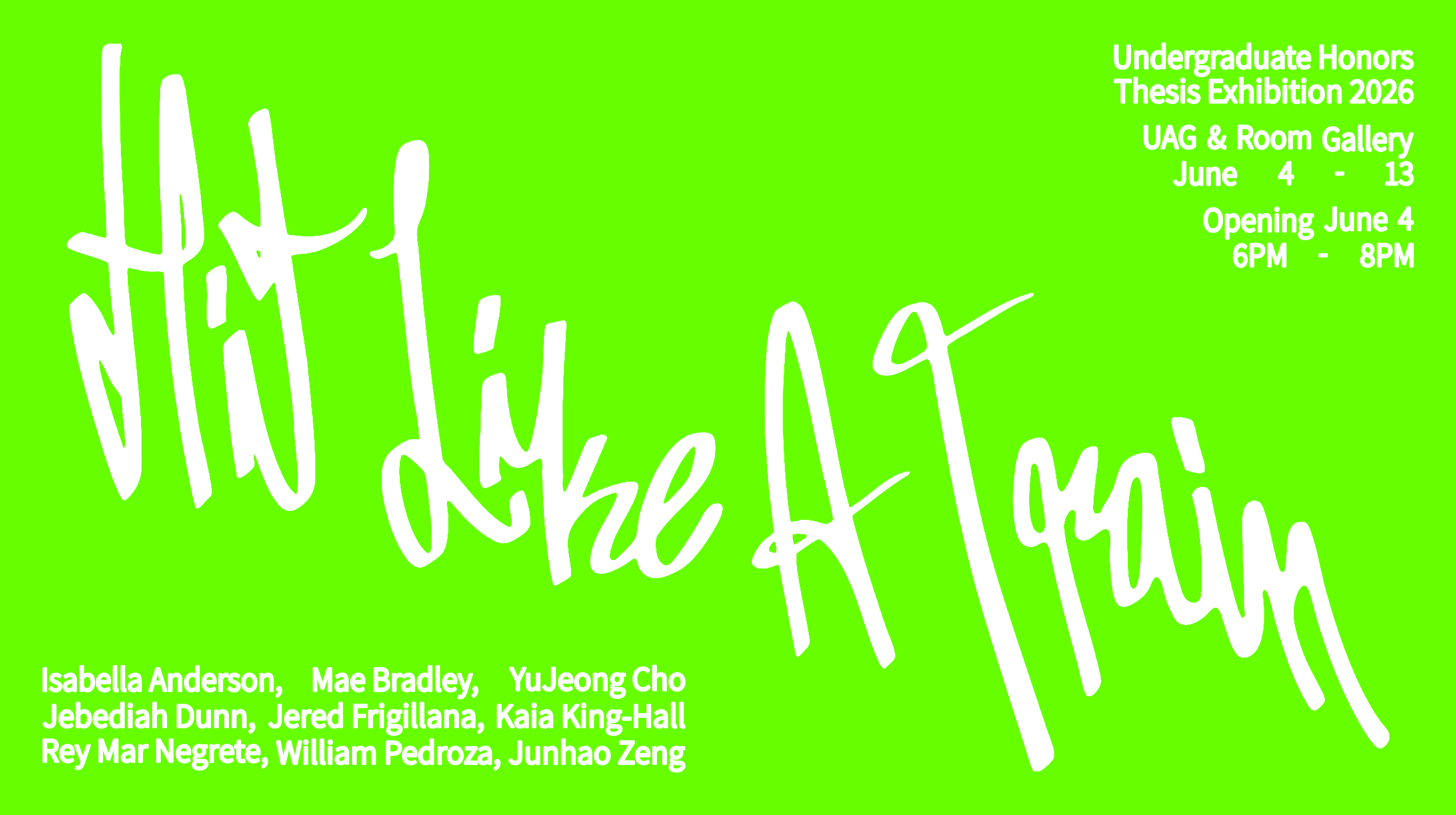
The Department of Art at the University of California, Irvine is pleased to present Hit Like a Train, the 2026 Undergraduate Honors Thesis Exhibition. The show features thesis presentations by nine students from the Art Honors cohort. Hit Like a Train brings together a diverse set of practices, encompassing painting, sculpture, ceramics, performance, video, installation, and interactivity. Exploring themes including identity formation, artificial intelligence, queer positionality, consumption, memory, nature, and perception, this ambitious group proposes urgent questions about agency and subjecthood within complex conditions.
Artists:
ISABELLA ANDERSON is a multimedia artist whose current work revolves around the connection between intimacy and time. She explores relationship dynamics through the preservation and transformation of personal ephemera, mirroring interactions through processes of material obsession. Paper towels, fabric, and acrylic medium act as main substrates in her work, chosen for their ephemeral and arresting qualities. She is particularly concerned with the nature of fleeting interactions, recognizing potential in the energy and intimacy formed between two people. The unpredictable outcomes following two people meeting, and the relationship (or lack thereof) that results presents a realm of possibility for her to explore and fabricate fictional alternate realities.
MAE BRADLEY is a multidisciplinary artist who aims to center objects and concepts that society has deemed ‘less than’, igniting conversations about systemic oppression and deanthropicentrizing our perspectives. As proof that there is value in alternative ways of life, she exalts the outcasts, undesirables, and societal rejects of our world. She reimagines these populations as talus, rockfall from a monolithic land mass, symbolically reaggregating them into new systems and forms. Working primarily in sculpture, she often uses materials such as clay and copper alongside found elements for their connection to the body, transformational properties, and ability to act as a palimpsest. Chemical interactions are engaged in both the process and the subject of the work, an activity she considers a direct collaboration with materials.
YUJEONG CHO'S work explores uncertainty, impermanence, and the shifting boundary between presence and absence. Influenced by Buddhist ideas of emptiness, she asks what it means for something to exist when bodies, thoughts, objects, landscapes, and paintings all eventually disappear. Working with powdered mineral pigment, oil paint, and safflower oil on flat canvas surfaces, Cho builds her paintings through an intuitive process of drawing, erasing, overlapping, and leaving traces behind. Each work is shaped by daily decisions, as the marks left by one version of the self are inherited and transformed by the next. Her landscapes resist fixed definitions: a form may appear as a mountain, water, moon, sun, destination, door, portal, or threshold. Their meaning depends on the viewer’s perception, memory, and state of mind.
JEBEDIAH DUNN is a transsexual, transdisciplinary artist from Southern California working throughout painting, metal sculpture, performance, and video. His work draws from political, social, and embodied experience stemming from an acutely trans* perspective of poetic rage. Using queer fury as a guiding force within his practice, he uses material exploration as a means towards critical inquiry and introspection. He pronounces trans* bodies within his work through experimental use of testosterone and estrogen cypionate as direct mediums. By pouring the hormonal oil on abstract steel forms or projecting through film, he asks questions about what makes a gendered body and, when distilled into its most essential oils, must we differentiate them?
JERED FRIGILLANA works through synergies. It grounds its practice in evolutionary biology and cultural mythologies, using the chiral relationships between these fields to explore queer identity. It creates site-specific, performance-based, and somatically informed works centered around the convergence of queerness, physical space, image-making, and the body. Its recent work utilizes the human-animal dichotomy as a framework for examining erotic taboos, divine rituals, and the natural world.
KAIA KING-HALL investigates how pleasure, fetishization, and consumption become intertwined with myth, shame, and deception. Taking an interdisciplinary approach, she works in sculpture, video, performance, audio, and painting, frequently employing her own body both physically and through representation. Her work complicates ideas of consent, perversion, and beauty. Depicting her body in various submissive postures proposes an ambiguous structure of power: is she putting herself in this position, or is someone else? Her upbringing in Northern Florida has become the central theme of her practice. Family encounters, advertisements, gift shops, and roadside attractions become source references, augmented by her personal photographic and video archives. Heightening the already present debauchery within Florida’s subcultures, she accentuates the perversion that often stands in broad daylight, but is disguised by tourism, play, and fantastical realities.
REY MAR NEGRETE attempts to navigate the reflexive relationship between humanity and nature—how humanity is irrevocably tied to the natural animal world despite our endeavors to retrofit the earth to fit our higher [or lower] desires. Referring to impressions and remnants from antiquity, he explores material traces that visibly age but resist decay. Particularly, he is interested in hair, horn, hide, carapace, shell, love, desire, intimacy and the processes involved in their transformation into artificial analogs or material resources for human consumption. His recent work is informed by his experiences curating community-centered arts programming for the Undocumented student body at UC Irvine, He transposes undocumented experiences from the present moment to artifacts from the future.
WILLIAM PEDROZA explores human experience and memory as driving forces for his work in photography and sculpture. His artistic impulse stems from years of questioning the worth of his identity and heritage, addressing what aspects he can or cannot identify with. This confirms his feeling of disconnection with his Colombian heritage. As a result, his sculptural work is a fabricated attempt to appreciate a life that never was. His new work, ¿De Donde Eres?, is based on a question he is often asked and, in turn, poses as a question back to his audience. The pieces It both refers to previous work and elements of traditional Colombian decor. Each form is a fabricated reconstruction of old homes from his family’s past with one being a reflection ofhimself.
JUNHAO ZENG is an interdisciplinary media artist working across coding, performance, video, projection, and interactive installation. His practice examines the changing relationship between human identity and artificial intelligence, especially the possibility of human-AI synergy and the danger of AI impersonation. Drawing from personal experience, family memory, and digital systems, he explores how AI interprets emotion, develops a simulated “personality,” and begins to affect the way humans understand care, intimacy, and the self. His work often treats AI not as a distant tool, but as an intimate presence that learns from human desire, loneliness, and dependence. Through projected bodies, responsive interfaces, synthetic voices, and tracked gestures, he asks what remains human when emotion can be measured, repeated, and performed by machines.