Wednesday, November 4, 2026 - 3:30pm to 5:30pm
Pedagogy of the Huddle: A Workshop with Ethan Philbrick
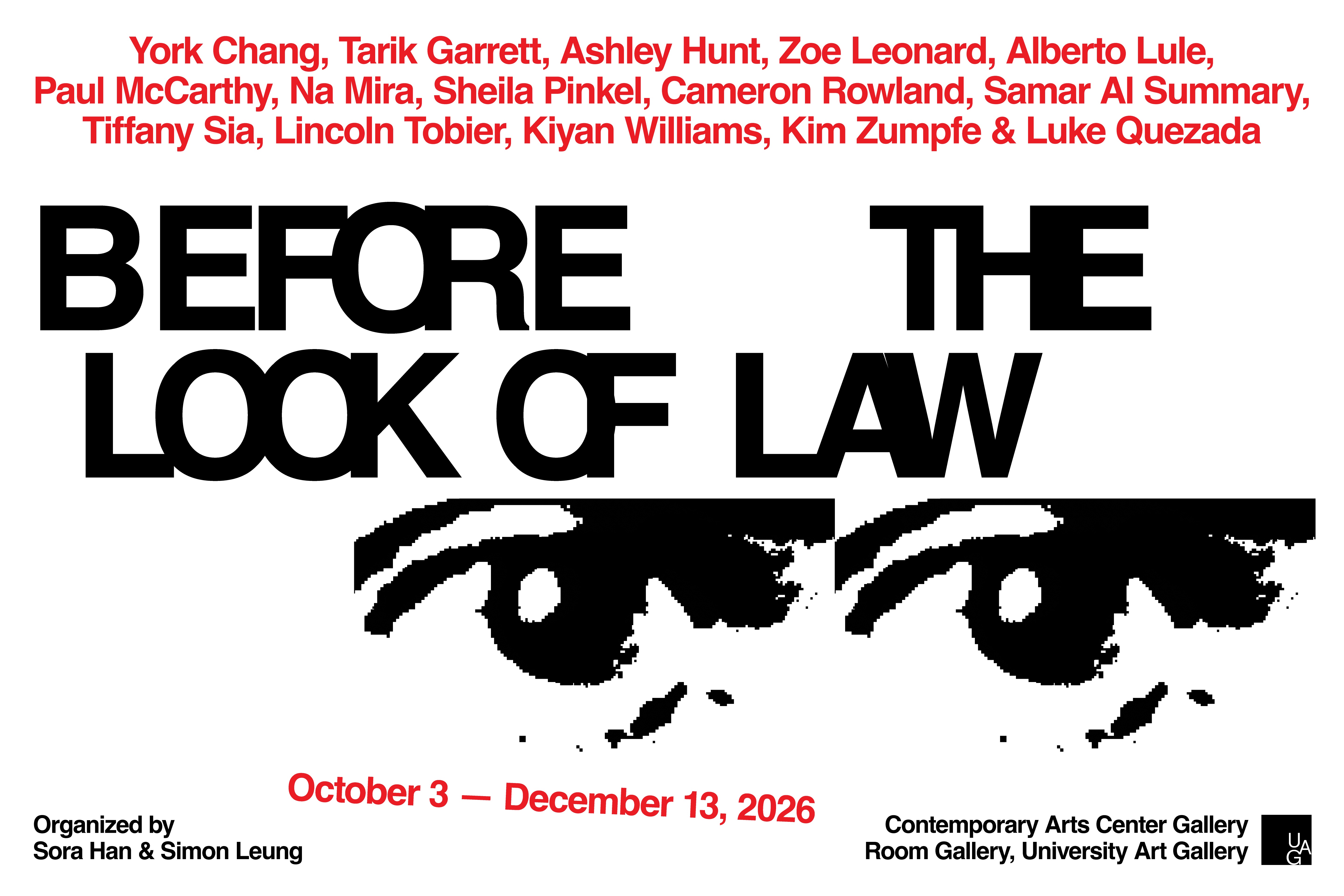
Before the Look of Law is a proposition based on several returns. The first is a return to Franz Kafka's parable, Before the Law (1915). There we encounter an image of a man waiting for permission to enter the Law, only to have the door shut on him in the final moments before death. He learns then that the door of Law was constructed not for everyone, as he had assumed, but solely for him. Law is an all-encompassing, isolating and unknowable framework of power to which our sense of the self and the social are tethered. At the same time, Law’s authority does not exist outside its arrangement of how and why it is given and with whom we come to gather before it.
The second is a return to The Look of Law, an exhibition organized by Simon Leung for the University Art Gallery in 2006. Responding to the "War on Terror" and wars waged by the United States in Iraq and Afghanistan, it charted the interstitial relationship between surveillance, the police, the prison, the military, the border; the erosion of the public sphere; the constant state of war; and the structural collusion between nationalism, corporate capitalism and mass media. From within these confluences, its artworks crystallized direct and residual effects of state power on the psyche.
The third is a return that layers the first two. It focuses on the intersection of Law and the psyche – the look of law – to ask a fundamental question embedded in Kafka’s parable: what does it mean to desire, to stand before, to be subject to, the power of Law? The difficulty of this question is compounded by unspeakably dire circumstances for society’s most vulnerable, including members of our campus. Ours is a time of a technologically accelerated hostile takeover of the collective psyche by a state/corporate/media collusion perpetuating unprecedented destruction of life and land, domestically and abroad.
The works presented in Before the Look of Law span those made in the early 1990’s to newly commissioned pieces. They reassemble the uncanny parts of real life that follow us into the place and time of waiting before the Law. They testify against militarized policing, mass imprisonment, global war-making, and the suppression of gender and sexual freedom. And they operate in double-time and longue durée to place an arrest on “the present.”
Their aesthetic strategies are far-ranging: from parrhesia to parody, speculative para-fiction to granular studies of materiality; from redistributing auras of the indexical to exploring the extra-legality of the readymade. They reflexively focus on the formation and mythification of Law’s capture of life as, among other dynamics, the work of artifice. Each possesses the ability of returning “the look of law” through dilating apertures in its gaze. Each holds urgent and abiding lessons about disobedience, aesthetic, political, and otherwise, at the edge of democracy and fascism.
Artists:
York Chang is an artist based in Los Angeles who makes conceptually driven work that considers the slippages between memory, language, images, symbols, and belief in our current epistemic crisis. His projects examine how our sense of truth, reality, and identity is shaped by the velocity of fractured narratives, evolving forms of propaganda, the theatrics of conflict, and the staged presentation of credibility. Related to his work as an attorney, Chang's practice often foregrounds the labor of looking through the searching and sorting of images, finding pattern and meaning within the noise of hyper-information.
Tarik Garrett is an interdisciplinary artist based in Los Angeles. Working across sculpture, video, photography, printmaking, and film, his practice is concerned with epistemologies that challenge Western Humanism, ocularcentrism, and the aesthetic conditions through which race, property, memory, and subjecthood are made sensible. His work has been exhibited at University Art Galleries, UC Irvine; Culver Center of the Arts, Riverside; Phase Gallery and Hunter Shaw Fine Arts, Los Angeles; LUMP, Raleigh; and Loyal, Stockholm. Currently, Garrett is a PhD candidate in Film and Visual Studies at Harvard University.
Ashley Hunt was born in Los Angeles in 1970 and lives and works in Los Angeles. Hunt is an artist, writer who co-directs the Photo and Media Program at CalArts. His practice examines the social, political, and aesthetic structures through which power is organized, with a sustained focus on the U.S. prison system and the movements that challenge it. Working across documentary, video installation, mapping, photography, and collaborative research, Hunt works directly with grassroots organizations such as Critical Resistance, the California Coalition for Women Prisoners, Underground Scholars, and Families and Friends of Louisiana’s Incarcerated Children. His work has been exhibited at MoMA and P.S.1, Project Row Houses, the Hammer Museum’s Made in L.A. Biennial, Tate Modern, and Documenta 12.
Zoe Leonard is an artist and poet based in New York City and Marfa, Texas. Balancing rigorous conceptualism with a deeply personal documentary perspective, her practice spans photography, sculpture, and site-specific installation to probe the politics of representation, looking, and display. Her conceptually charged work engages deeply with themes of gender and sexuality, loss and mourning, migration, displacement, and the urban landscape, frequently considering how the photographic medium constructs public and private histories. Her work has been showcased globally in milestone exhibitions such as Documenta IX and XII, multiple Whitney Biennials, and solo retrospectives at the Whitney Museum of American Art, Museum of Contemporary Art Los Angeles, and MoMA.
Alberto Lule lives and works in Los Angeles. Drawing from his own experiences with incarceration, his practice examines mass incarceration and the prison industrial complex in the United States, particularly the California prison system, and its intersections with immigration, the unhoused, drug addiction, and mental health. His work considers the structural similarities between correctional institutions and other institutional systems, including higher education, using art as a means to expose and interrogate how these systems operate. Lule is a PhD candidate in the Performance Studies Program at UCLA and continues to advocate for currently and formerly incarcerated people through his art, teaching, and activism.
Paul McCarthy lives and works in Los Angeles. He first established a multi-faceted artistic practice, which sought to break the limitations of painting by using unorthodox materials such as bodily fluids and food. He has since become known for visceral, often hauntingly humorous work in a variety of mediums—from performance, photography, film and video, to sculpture, drawing and painting. During the 1990s, he extended his practice into installations and stand-alone sculptural figures, utilizing a range of materials such as fiberglass, silicone, animatronics and inflatable vinyl. Playing on popular illusions and cultural myths, fantasy and reality collide in a delirious yet poignant exploration of the subconscious, in works that simultaneously challenge the viewer’s phenomenological expectations.
Na Mira works at the edges of perception. Recent and forthcoming projects have been presented at Museum of Modern Art, New York; Institute of Contemporary Art, Los Angeles; Berkeley Art Museum and Pacific Film Archive; Museum of Contemporary Art, Chicago; Museum of Contemporary Art, Tucson, Midway Contemporary Art, Minneapolis; Art Sonje Center, Seoul; and Kunsthalle Zurich; as well as the Made in L.A. Biennial, SITE Santa Fe International Biennial, Gwangju Biennale, Venice Biennale, and Whitney Biennial. An Assistant Professor of Art at the University of California, Irvine, Wendy’s Subway published the first collection of Mira’s writing, The Book of Na, in 2022.
Sheila Pinkel was born in Newport News, Virginia in 1941 and lives and works in Los Angeles. Her four-decade practice spans experimental light studies, socially engaged documentary projects, and public art, making visible structures and phenomena that often remain unseen in nature and culture. Her work has been exhibited extensively since the late 1970s and is held in the collections of the Los Angeles County Museum of Art; San Francisco Museum of Modern Art; Denver Art Museum; and Musée National d’Art Moderne–Centre Pompidou, Paris.
Cameron Rowland lives and works in Queens, New York. Rowland has had solo exhibitions at in solo exhibitions at Dia Art Foundation, Beacon; Museum MMK für Moderne Kunst, Frankfurt; Institute of Contemporary Arts, London; Museum of Contemporary Art, Los Angeles; Galerie Buchholz, Cologne, Germany; Établissement d'en face, Brussels; Artists Space, New York and Essex Street / Maxwell Graham, New York.
Samar Al Summary was born in Jeddah, Saudi Arabia in 1988. Working across video, installation, photography, text, and painting, her practice disorients distinctions between west and east, progress and regress, and belatedness and contemporaneity to examine the historical, economic, and material contexts in which power takes shape. Recent presentations include a solo exhibition at ICA LA, the Istanbul Biennial, and DOK Leipzig, where What Goes Up received the Silver Dove Award for Best International Documentary Short.
Tiffany Sia is an artist, filmmaker, and writer who lives and works in New York. Her films and writing explore fugitive and exilic cinema, national identity, and the politics of place. She has had solo exhibitions at Artists Space, New York; Cantor Arts Center at Stanford University; and Mudam Luxembourg, and her work has been presented at the Museum of Modern Art, New York; Seoul Museum of Art; Hessel Museum of Art; New York Film Festival; and Toronto International Film Festival; amongst others. She is currently at work on a forthcoming book, They Prefer Us When We're Dead, to be published by no place press (MIT).
Lincoln Tobier was born in New York in 1964 and lives in Los Angeles. Working across sculpture, painting, photography, video, sound, radio, installation, public projects, and theater, the basis of Tobier’s artwork is a critical reflection on the public sphere; the systemic erosion of forms for open exchange and debate; and the structural and legal encroachment on democratic ethos and institutions. Linking the relationship between aesthetics, ideology, and media, Tobier’s work examines the power and effects of contemporary mass communication in both the affirmative sense of its possibilities for cultural production and community building—and also its function as a deleterious means for financial and political gain by way of emotional manipulation. His work has been exhibited at the Museum of Contemporary Art, Los Angeles; Los Angeles County Museum of Art; Biennale di Venezia; MAK Center, Los Angeles; Hessel Museum of Art at Bard College; and the Hammer Museum, Los Angeles; amongst others.
Kiyan Williams is a multidisciplinary artist based in New York City. Working fluidly across sculpture, performance, video, and installation, their process-driven practice explores the legacies of dispossession, diasporic subjectivity, and national memory. By unearthing Black queer and trans embodiment through the use of unconventional, symbolic materials like soil, environmental elements, and architectural debris, Williams' work subverts dominant historical narratives to create sites of recovery, memorialization, and healing. Their work has been exhibited at the Whitney Museum of American Art (including the 2024 Whitney Biennial), Brooklyn Museum, the Hammer Museum, The Hirshhorn, SculptureCenter, and The Shed. Currently, Williams is an assistant professor in the Sculpture and Extended Media Department at Virginia Commonwealth University.
Luke Quezada is a media artist and designer from Los Angeles whose practice draws on interaction design, scientific visualization, and emerging technologies. He currently develops interactive scientific visualizations for quantum computing and specializes in large-scale photogrammetric reconstructions. He is an Adjunct Assistant Professor at the University of Southern California's School of Cinematic Arts. His recent projects include scientific visualizations of semiconductor fabrication methods and interactive and media-based elements for Sacrifice Zones: Los Angeles at the Natural History Museum of Los Angeles County.
Kim Zumpfe is an interdisciplinary artist and educator who lives and works in Los Angeles. Her work has been exhibited and performed at Los Angeles Contemporary Exhibitions (LACE); Gallery TPW, Toronto; Bangkok Biennial’s MAHA Pavilion; MOCA Geffen; Museum of Contemporary Art San Diego; Human Resources Los Angeles; Torrance Art Museum; CSUF Grand Central Art Center; among others. Zumpfe is also co-producer of Voidwave, a radio program featuring experimental sound works by femme, queer, wayward, and non-conforming artists. Zumpfe is currently an Adjunct Assistant Professor at University of Southern California, and a Visiting Associate Professor in MassArt’s Graduate Program.
Curators:
Sora Han is Professor of Criminology, Law and Society, Comparative Literature, and Law at the University of California, Irvine. She is the author of Mu, 49 Marks of Abolition (Duke UP 2024), Letters of the Law (Stanford UP 2016), and co-author of the law casebook, Comparative Equality and Anti-Discrimination Law, 3rd Edition (Edward Elgar, 2020). Her first book of poetry, to regard a wave, was published by Selva Oscura Press in 2024.
Simon Leung is a project-based artist whose work in various media addresses “the ethical,” broadly defined, as challenge, possibility and limit. They have presented work internationally since the 1980s, including at the Whitney Biennial (1993), Venice Biennale (2003), and Gwangju Biennale (2018). Leung is Professor and Head of the New Genres Area in the Department of Art at UC Irvine.
Before the Look of Law is jointly presented by the UC Irvine Claire Trevor School of the Arts’ University Art Galleries (UAG) and Department of Art, and UCI Critical Theory.
Major support is provided by the Terra Foundation for American Art, Matt Bailey, the Claire Trevor Society, UCI Illuminations, and the UCI Poetic Justice Initiative.
Additional program support is provided by the Alec Glasser Center for the Power of Music and Social Change.
In partnership with UCI International Center for Writing and Translation, UCI Department of Asian American Studies, UCI Department of East Asian Languages and Literatures, UCI Department of Art History, UCI Department of Film and Media Studies, UCI Department of History, UCI Center in Law, Society and Culture, UCI School of Humanities, UCI Department of Gender & Sexuality Studies, UCI Department of Criminology, Law & Society, and UCI Department of Comparative Literature.
“What is to be Done?”
Ethan Philbrick & Ensemble
“Formerly Incarcerated Huddle (After Simone Forti)”
Alberto Lule & Ensemble
10:00 - 10:45am
Exhibition Walkthrough with Sora Han & Simon Leung
11 - 12:15pm
Staged Reading of Dionne Brand’s A Map to the Door of No Return
Adapted and Directed by Jaye Austin Williams
Read by Malenia Friday, Christian Rabin, Jacob Reimer, Olamina Jiménez Sánchez, and more
2:00 - 4:45pm
Roundtable discussions with Swethaa Ballakrishnen, York Chang, Tarik Garrett, Sora Han, Annie Lai, Zoe Leonard, Simon Leung, Na Mira, Xyta Maya Murray, Tiffany Sia, Lincoln Tobier, Jaye Austin Williams, and more
5:00 - 6:30pm
Keynote lecture by Judith Butler, “Kafka Before the Law”